 Add to Chrome
 Add to Firefox
 Add to Edge
PAI-Studio: Cinematic Video Background Replacement with Camera-Aware Motion
May 31, 2026
We present PAI-Studio, a new reference-conditioned video synthesis task that addresses a long-standing challenge in cinematic background replacement: generating dynamic backgrounds aligned with foreground motion while preserving foreground identity, matching reference scene appearance, and achieving globally consistent illumination with realistic foreground relighting. Existing open-source systems and commercial APIs cannot simultaneously ensure motion-consistent background generation, high-fidelity foreground relighting and foreground identity preservation, often resulting in static backgrounds, inconsistent boundaries, and noticeable compositing artifacts. To bridge this gap, we build upon a Diffusion Transformer video backbone and reformulate the problem as an in-context conditional generation task. Through bidirectional attention, our model jointly captures foreground dynamics and background reference information within a unified architecture. We further construct a 30K-scale dataset sourced from high-quality films and online videos to support this task. Extensive evaluations demonstrate that our method significantly outperforms existing open-source and commercial API solutions.

AnySurf: Any Surface Generation with Directed Edge
May 23, 2026Open surface components prevail in real industrial 3D content and support rendering, physical simulation and geometric editing. Garments serve as a typical open surface type, with numerous existing generation methods leveraging sewing patterns to generate 2D panels and stitch them into 3D shapes. Such domain-specific designs lack scalability and cannot generalize to shoes and accessories. Common field-based 3D generators prioritize watertight meshes and tend to create flawed double-layer structures on open surfaces. Though Trellis2 adopts field-free representation, its open surface results still contain normal and topology errors. We present AnySurf, a unified framework generating open, closed and hybrid 3D surfaces with accurate face orientation. Built on directed-edge enhanced Flexible Dual Grid (FDG-D), our representation retains normal direction information via oriented grid edges. We also propose ROS-FT post-training and a lightweight DE-Adapter with merely 1% extra parameters, facilitating directed edge learning while preserving original generation performance. We further construct Outfit3D dataset containing industrial garments and closed accessories. Our work transforms garment modeling into a universal 3D generation task. Experimental results demonstrate superior mesh quality and better practicality for downstream applications.
SWEET: Sparse World Modeling with Image Editing for Embodied Task Execution
May 19, 2026Visual prediction has emerged as a promising paradigm for embodied control, where future observations are generated and then translated into actions. However, dense video generation is computationally expensive and often unnecessary for many manipulation tasks, whose progress can be summarized by a small number of task-relevant visual states. In this work, we study whether image editing models can serve as sparse visual world models for robot manipulation by predicting task-level future states without dense video rollout. We first conduct a controlled comparison between the video generation model Wan2.2 and the image editing model FLUX-Kontext under the same robotic data setting, and find that image editing produces more reliable task-level keyframes with better visual fidelity and substantially lower inference cost. Motivated by this observation, we propose SWEET, a one-shot sparse visual planning framework that progressively generates a sequence of task-relevant manipulation keyframes through successive image editing, conditioned on language instructions and optional arrow-based spatial guidance. A goal-conditioned diffusion action predictor then converts adjacent imagined keyframes into executable action chunks. To reduce the mismatch between real and edited visual subgoals, we further introduce a mixed-training strategy with filtered edited targets. Experiments on DROID and RoboMimic show that SWEET improves keyframe prediction across seen and unseen scenes and enables a full pipeline from sequential keyframe planning to executable robot actions, suggesting that image editing is a promising and underexplored direction for embodied visual prediction.
OmniHumanoid: Streaming Cross-Embodiment Video Generation with Paired-Free Adaptation
May 12, 2026Cross-embodiment video generation aims to transfer motions across different humanoid embodiments, such as human-to-robot and robot-to-robot, enabling scalable data generation for embodied intelligence. A major challenge in this setting is that motion dynamics are partly transferable across embodiments, whereas appearance and morphology remain embodiment-specific. Existing approaches often entangle these factors, and many require paired data for every target embodiment, which limits scalability to new robots. We present OmniHumanoid, a framework that factorizes transferable motion learning and embodiment-specific adaptation. Our method learns a shared motion transfer model from motion-aligned paired videos spanning multiple embodiments, while adapting to a new embodiment using only unpaired videos through lightweight embodiment-specific adapters. To reduce interference between motion transfer and embodiment adaptation, we further introduce a branch-isolated attention design that separates motion conditioning from embodiment-specific modulation. In addition, we construct a synthetic cross-embodiment dataset with motion-aligned paired videos rendered across diverse humanoid assets, scenes, and viewpoints. Experiments on both synthetic and real-world benchmarks show that OmniHumanoid achieves strong motion fidelity and embodiment consistency, while enabling scalable adaptation to unseen humanoid embodiments without retraining the shared motion model.
OpenWorldLib: A Unified Codebase and Definition of Advanced World Models
Apr 06, 2026World models have garnered significant attention as a promising research direction in artificial intelligence, yet a clear and unified definition remains lacking. In this paper, we introduce OpenWorldLib, a comprehensive and standardized inference framework for Advanced World Models. Drawing on the evolution of world models, we propose a clear definition: a world model is a model or framework centered on perception, equipped with interaction and long-term memory capabilities, for understanding and predicting the complex world. We further systematically categorize the essential capabilities of world models. Based on this definition, OpenWorldLib integrates models across different tasks within a unified framework, enabling efficient reuse and collaborative inference. Finally, we present additional reflections and analyses on potential future directions for world model research. Code link: https://github.com/OpenDCAI/OpenWorldLib
UENR-600K: A Large-Scale Physically Grounded Dataset for Nighttime Video Deraining
Apr 06, 2026Nighttime video deraining is uniquely challenging because raindrops interact with artificial lighting. Unlike daytime white rain, nighttime rain takes on various colors and appears locally illuminated. Existing small-scale synthetic datasets rely on 2D rain overlays and fail to capture these physical properties, causing models to generalize poorly to real-world night rain. Meanwhile, capturing real paired nighttime videos remains impractical because rain effects cannot be isolated from other degradations like sensor noise. To bridge this gap, we introduce UENR-600K, a large-scale, physically grounded dataset containing 600,000 1080p frame pairs. We utilize Unreal Engine to simulate rain as 3D particles within virtual environments. This approach guarantees photorealism and physically real raindrops, capturing correct details like color refractions, scene occlusions, rain curtains. Leveraging this high-quality data, we establish a new state-of-the-art baseline by adapting the Wan 2.2 video generation model. Our baseline treat deraining as a video-to-video generation task, exploiting strong generative priors to almost entirely bridge the sim-to-real gap. Extensive benchmarking demonstrates that models trained on our dataset generalize significantly better to real-world videos. Project page: https://showlab.github.io/UENR-600K/.
Unlocking the Latent Canvas: Eliciting and Benchmarking Symbolic Visual Expression in LLMs
Mar 15, 2026Current multimodal approaches predominantly treat visual generation as an external process, relying on pixel rendering or code execution, thereby overlooking the native visual representation capabilities latent within Large Language Models (LLMs). In this work, we unlock this potential through ASCII art, a compact, efficient, and text-native visual format. We introduce SVE-ASCII, a unified framework designed to elicit and benchmark Symbolic Visual Expression directly within the pure text space. To address the scarcity of systematic resources, we construct ASCIIArt-7K, a high-quality dataset synthesized via a novel "Seed-and-Evolve" pipeline that augments human-curated anchors through in-context stylistic editing. We further implement a unified instruction-tuning strategy that jointly optimizes for both Generation (Text-to-ASCII) and Understanding (ASCII-to-Text). Crucially, our experiments reveal a critical phenomenon regarding task duality: while it is established that perception aids generation, we provide compelling evidence that generative training significantly enhances visual comprehension. This confirms a mutually reinforcing cycle in symbolic visual processing, a relationship previously hypothesized but rarely empirically demonstrated in the visual domain. We release our dataset, the ASCIIArt-Bench benchmark, and the SVE-ASCII model, establishing a robust baseline for native text-based visual intelligence.
SIGMA: Selective-Interleaved Generation with Multi-Attribute Tokens
Feb 07, 2026Recent unified models such as Bagel demonstrate that paired image-edit data can effectively align multiple visual tasks within a single diffusion transformer. However, these models remain limited to single-condition inputs and lack the flexibility needed to synthesize results from multiple heterogeneous sources. We present SIGMA (Selective-Interleaved Generation with Multi-Attribute Tokens), a unified post-training framework that enables interleaved multi-condition generation within diffusion transformers. SIGMA introduces selective multi-attribute tokens, including style, content, subject, and identity tokens, which allow the model to interpret and compose multiple visual conditions in an interleaved text-image sequence. Through post-training on the Bagel unified backbone with 700K interleaved examples, SIGMA supports compositional editing, selective attribute transfer, and fine-grained multimodal alignment. Extensive experiments show that SIGMA improves controllability, cross-condition consistency, and visual quality across diverse editing and generation tasks, with substantial gains over Bagel on compositional tasks.
Loom: Diffusion-Transformer for Interleaved Generation
Dec 20, 2025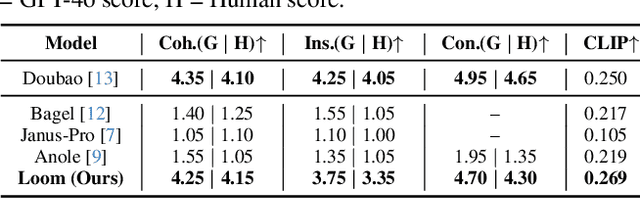
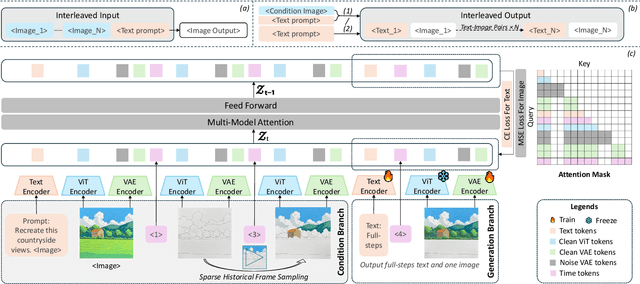
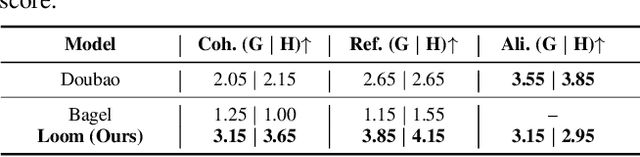
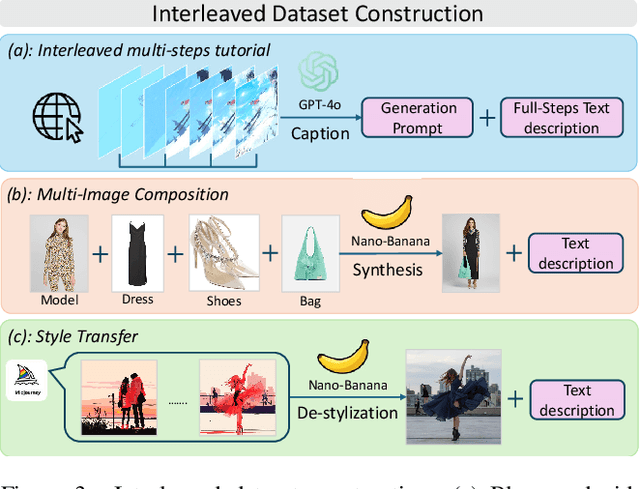
Interleaved text-image generation aims to jointly produce coherent visual frames and aligned textual descriptions within a single sequence, enabling tasks such as style transfer, compositional synthesis, and procedural tutorials. We present Loom, a unified diffusion-transformer framework for interleaved text-image generation. Loom extends the Bagel unified model via full-parameter fine-tuning and an interleaved architecture that alternates textual and visual embeddings for multi-condition reasoning and sequential planning. A language planning strategy first decomposes a user instruction into stepwise prompts and frame embeddings, which guide temporally consistent synthesis. For each frame, Loom conditions on a small set of sampled prior frames together with the global textual context, rather than concatenating all history, yielding controllable and efficient long-horizon generation. Across style transfer, compositional generation, and tutorial-like procedures, Loom delivers superior compositionality, temporal coherence, and text-image alignment. Experiments demonstrate that Loom substantially outperforms the open-source baseline Anole, achieving an average gain of 2.6 points (on a 5-point scale) across temporal and semantic metrics in text-to-interleaved tasks. We also curate a 50K interleaved tutorial dataset and demonstrate strong improvements over unified and diffusion editing baselines.
Mitty: Diffusion-based Human-to-Robot Video Generation
Dec 19, 2025Learning directly from human demonstration videos is a key milestone toward scalable and generalizable robot learning. Yet existing methods rely on intermediate representations such as keypoints or trajectories, introducing information loss and cumulative errors that harm temporal and visual consistency. We present Mitty, a Diffusion Transformer that enables video In-Context Learning for end-to-end Human2Robot video generation. Built on a pretrained video diffusion model, Mitty leverages strong visual-temporal priors to translate human demonstrations into robot-execution videos without action labels or intermediate abstractions. Demonstration videos are compressed into condition tokens and fused with robot denoising tokens through bidirectional attention during diffusion. To mitigate paired-data scarcity, we also develop an automatic synthesis pipeline that produces high-quality human-robot pairs from large egocentric datasets. Experiments on Human2Robot and EPIC-Kitchens show that Mitty delivers state-of-the-art results, strong generalization to unseen environments, and new insights for scalable robot learning from human observations.